Breadwinning and the Bedroom: How Income and Education Shape Relationship Stability and Domestic Labour in Canada
As gender roles continue to evolve in the 21st century, particularly in the wake of the Gender Revolution, the dynamics of heterosexual relationships are undergoing profound shifts. This study explores how women’s income and education shape relationship status and the division of household labour among Canadian women aged 20-39. Using 2017 cross-sectional data from the General Social Survey-Families and SPSS for bivariate and multivariate analyses, findings show that education is a stronger predictor of relationship status than income.
As Canada’s single population grows (Stechyson 2024), it becomes increasingly important to examine how young people, specifically Millennials and Gen Z, navigate love and stability amid shifting gender expectations in the wake of the Gender Revolution, a topic that remains underexplored in sociological research. In particular, limited attention has been paid to how female breadwinning among these younger generations shapes relationship status and the division of household labour in a Canadian context. To address this gap, the present study investigates two research questions:
1. Is there a higher likelihood for women to be in one relationship status over another (e.g. single, married, cohabitating, divorced) based on their income level?
2. How does women’ s income level influence the division of household labour in heterosexual relationships?
I felt compelled to research this topic after noticing a pattern in popular culture: the success of a woman’s career is often depicted as causing challenges in romance and long-term relationships. As an ambitious woman, I found this possibility unsettling and wanted to explore whether it was true.
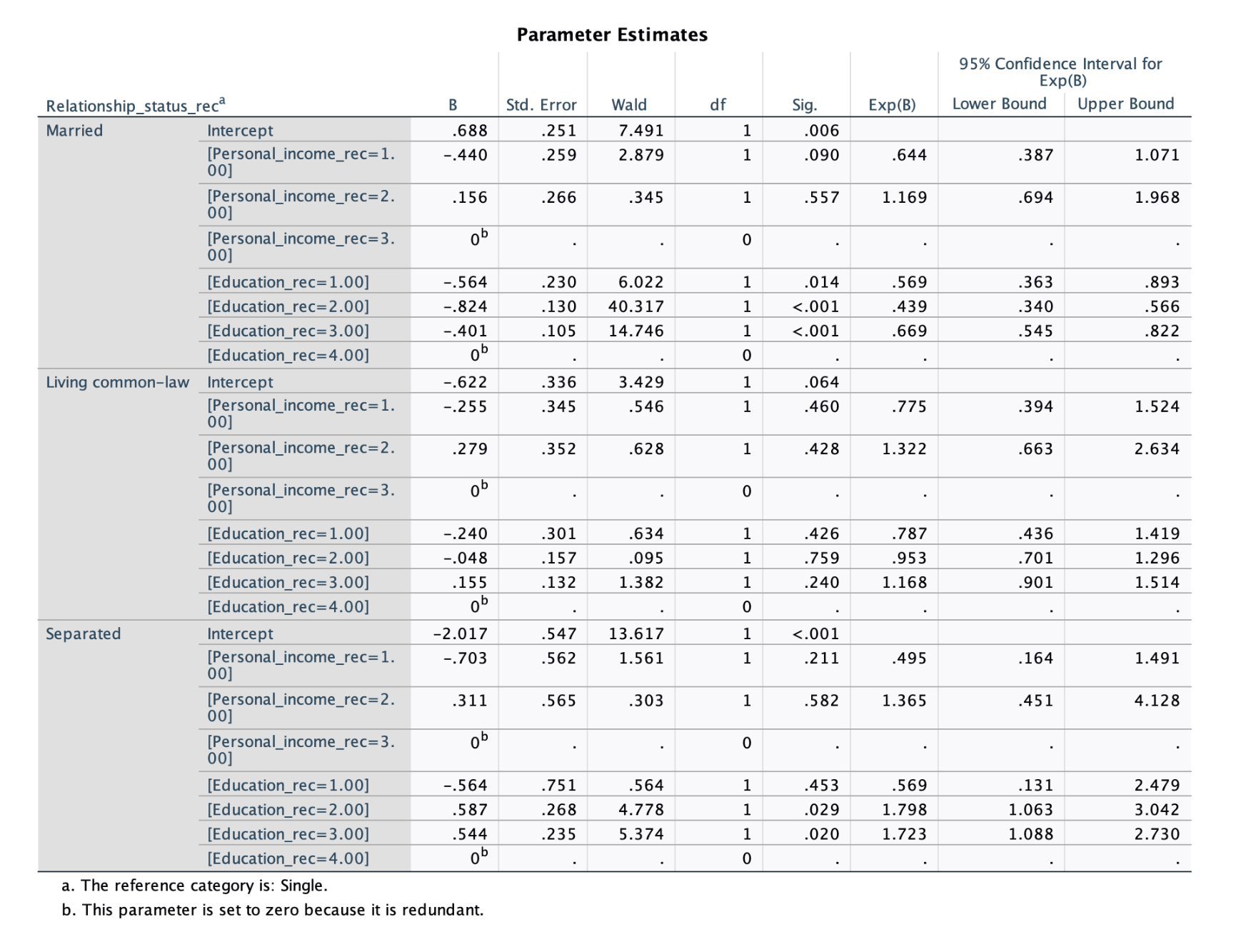
I was the sole researcher on this quantitative project. What struck me most about the study was how education, more than income, influence women’s relational stability (. Changes in educational attainment have reshaped relationship dynamics, including declining rates of educational hypergamy (men having higher education than women) and rising rates of homogamy (partners with similar education) and hypogamy (women having higher education than men) (Oláh et al. 2018). Notably, mid-educated women are significantly more likely to be separated than single, compared to highly educated women, which adds nuance to the existing literature on this topic. It suggests that educational stratification is not only predictive of marriage entry, but also of its durability.
Findings
Lower-educated women were significantly more likely to be separated and less likely to be married than their highly educated peers. However, income did influence domestic labour: lower-income women were less likely to report male partner involvement in meal preparation and dishwashing, which underscores the persistent impact of traditional gender norms. These results offer nuanced insight into the evolving contours of intimacy, domestic labour, and stability in contemporary Canadian relationships.